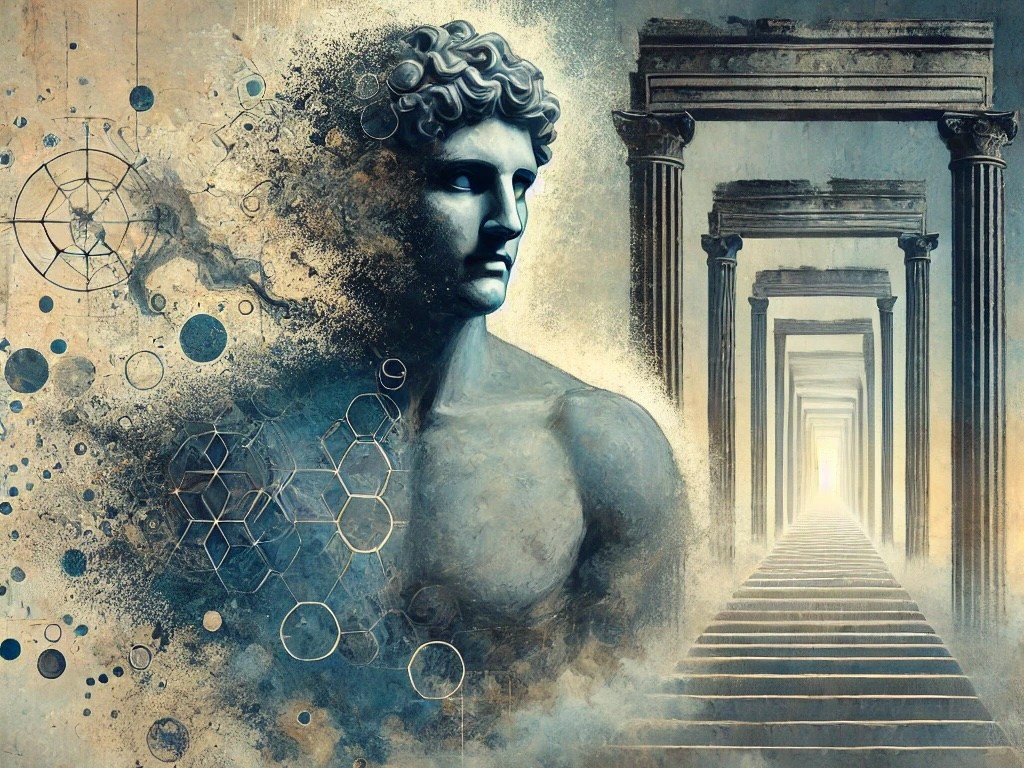
When two people meet for the first time and their eyes cross, there is a fleeting yet intense moment in which they are no longer strangers, yet not quite acquaintances. In that precise instant—dense with possibility—they inhabit a suspended relational space where proximity slowly emerges from the fog of indeterminacy.
When we are about to embark on a long journey, caught up in the frenzy of preparation, there is a moment when our gaze oscillates between the familiar objects of home and the unknown horizon ahead. In that precise instant—laden with uncertainty and hope—we dwell in a peculiar kind of home, a liminal space where the known and the unknown seem to touch, though along interior coordinates we cannot fully grasp.
Likewise, when a patient hears a devastating diagnosis from a doctor, one that will irreversibly change their life, they find themselves caught between two conditions: the person they have been up until that moment and the one they will, unwillingly, become. In that precise instant, they experience the inescapability of the threshold as an existential condition.
These three examples—among countless others—reveal how deeply liminality shapes our lives. To exist is to navigate a continuous interplay between a “before” and a “not yet,” not as an incidental feature of experience, but as something structural, something constitutive of our very nature. It is through the crossing of these thresholds that our identity takes shape.
Yet, despite this fundamental reality, we struggle to accept our liminal nature, perhaps because of an innate need for control and predictability. Perpetual transition generates an existential anxiety that we attempt to quell by clinging to illusory certainties—much like sailors caught in a storm, desperately trying to anchor their ships to what turn out to be mirages upon the water.
But it hasn’t always been this way. Traditional societies understood that fundamental life transitions could not be faced alone. Around this awareness, they constructed communal rituals that provided a framework of meaning, embedding personal and collective transformation within a shared symbolic structure.
Even today, on the island of Pentecost in Vanuatu, the ancient ritual of “land diving” (or “gol”) marks the passage of young men into adulthood. They leap from wooden towers between twenty and thirty meters high, their ankles bound with vines that break their fall just before they hit the ground. The tower itself is built according to a precise symbolism, each part corresponding to a segment of the human body, from the ankles to the head. This ritual forms a sophisticated symbolic system: the leap represents the death of adolescence and the rebirth of the individual as an adult, while the anthropomorphic structure of the tower reinforces the deep connection between the human body and the social order.
In modern societies, rituals—weddings, graduations, and various ceremonies—still exist, but they have undergone profound transformations. They no longer function as true rites of passage that fundamentally alter the identity of participants. Instead, they have become what anthropologist Victor Turner once described as “liminoid phenomena.” These experiences mimic the structure of traditional liminality but lack its transformative power, reflecting a broader shift in the way modern culture perceives and values ritual.
As scholar Bjørn Thomassen recently noted in Liminality and the Modern, contemporary rituals have lost their capacity to mediate meaningful transformations because the social and symbolic fabric that once gave them significance has unraveled. This erosion reaches its peak in what he calls limivoid experiences, where the pursuit of limits becomes an end in itself, detached from any real potential for change. Consider, for instance, bungee jumping: while it retains the outward form of the gol ritual, it is entirely stripped of its ability to mediate a genuine personal or social transformation.
This loss of deep meaning does not eliminate the fundamental human need to structure life transitions. Instead, it creates a paradox that is characteristic of modernity: on one hand, there is an obsessive pursuit of intense experiences—what are often described as “kicks”; on the other, an increasing inability to fully inhabit the transformative moments that naturally arise in the course of life. This tension reflects a deeper struggle: the desire for peak experiences versus the inability to integrate them into a meaningful process of personal growth.
Take, for example, immersive experiences like escape rooms, virtual reality concerts, or the social media challenges that push participants to test their limits in search of instant validation. These phenomena are not merely trends; they are symptoms of a broader difficulty in confronting life’s real liminal moments—birth, death, love, illness. The commercialization and trivialization of liminality risk producing an anthropological impoverishment, a progressive desensitization to the very processes that define human existence.
The condition we find ourselves in today could be described as an “inverted Proteus syndrome.” According to Homer, the Greek god Proteus possessed the power of constant transformation and would only reveal his prophetic wisdom to those who could withstand his endless metamorphoses. Contemporary humanity, by contrast, seems to suffer from a paradoxical reversal of this dynamic. In our rejection of liminality and our preference for fixity, we deny ourselves the very existential wisdom that comes from consciously crossing life’s thresholds.
Yet, no matter how persistently we try to suppress it, liminality remains at the core of human existence. And so, it is in this unresolved tension—between being and wanting to be, between the liminal and its denial—that perhaps the defining drama of our age unfolds: in our desperate attempt to control the uncontrollable, we risk losing precisely what makes us authentically human.
(This article was originally published in Italian in Gutenberg (March 14, 2025), the weekly cultural supplement of the newspaper Avvenire)


 Esercizi di vita desta