
Giovanni Scarafile
DOI: 10.6084/m9.figshare.30353536
Introduction
«Ad evidentiam quaestionis oportet declarare quid nomine significetur» is a typical expression found in medieval scholastic treatises. It is an opening formula signaling the need to clarify the meaning of terms before beginning any discussion. This was not a stylistic flourish but a genuine methodological safeguard: without preliminary definitions, the risk of moving within an ambiguous field and talking past one another was remarkably high.
The explicatio terminorum was an indispensable preliminary step. It served to delineate the field of discussion, to prevent debates from collapsing into lexical misunderstandings, and to ensure that the exchange took place on at least a linguistically shared basis. It was, ultimately, a form of intellectual prudence: before engaging with the complexity of problems, there was an awareness that agreement on the meaning of words was a necessary first step.
Today, when we talk about dialogue, we would need a similar preliminary gesture, since we live in a context where there is a prevailing belief that certain notions have little left to teach us. Consider terms like “friendship” or “democracy.” We use them daily, as if their meaning were obvious and universally shared, whereas in reality they contain historical layers, semantic ambiguities, and unresolved normative tensions. “Dialogue” belongs to the same family of taken-for-granted notions, which we believe we already fully understand and therefore consider immune to further scrutiny.
To recover at least the spirit of explicatio today would mean acknowledging that dialogue is neither univocal nor self-evident. It is a complex notion that requires critical examination of its boundaries and implications. This need becomes even clearer if we begin with a shared experience: how difficult genuine understanding can be. This difficulty is not abstract; it is a fracture we encounter daily.
In family life, for example, a child might perceive as criticism a sentence a parent spoke with affectionate intent, producing a misunderstanding neither anticipated. In professional settings, how often does a meeting get stuck because the same word—“priority,” for instance—is interpreted differently by management and by the operational team, creating conflicts deeper than the initial issue. Or in institutional communication, it is not uncommon for a joint project among several organizations to fail simply because what one group means by “transparency” another understands as “pointless exposure” or even “risk.”
These concrete experiences expose how fragile the presumption of immediate mutual understanding really is. Often, we feel misunderstood, and that sense of incommunicability wounds us, sometimes irritates us, but at times also has the opposite effect: it can make us more willing to recognize that the word “dialogue” cannot be treated as an obvious, fully owned concept. It is precisely this evidence—born of the everyday difficulty of understanding one another—that reopens the space for a rigorous reflection on dialogue, its conditions, and its limits.
As Edgar H. Schein, one of the leading scholars of organizational culture and learning, observes, “We must learn to listen to ourselves before we can truly understand others.”[1]
These words are not a motivational slogan but a methodological indication: before asking the other to be comprehensible, we must make intelligible to ourselves the filters, perceptual habits, and tacit assumptions that distort our listening.
In what follows, I intend to examine the link between dialogue and change. To do this, we must begin with the awareness that the term “dialogue” is used in many different senses, and that this polysemy, if left unexamined, can confuse more than it clarifies. Hence the need for a preliminary explicatio terminorum to delimit the forms of dialogue under consideration. Only after this will it be possible to confront the decisive question: what is the relationship between dialogue and change?
Throughout this essay, the reader will encounter three distinct ways of understanding dialogue, each linked to a different type of change. The first model, discussed in §1, conceives dialogue as the transmission of information: here, change is a “maintenance change,” useful for removing obstacles and restoring the communicative flow but lacking any transformative impact on the interlocutors’ identities. The second model, examined in §2, considers dialogue as negotiation and compromise: the resulting “calibration change” makes it possible to bring initially distant positions closer and to reach workable solutions, while remaining within the logic of adjustment and without questioning the underlying assumptions. Only the third model, which I call generative or evenemential dialogue, analyzed in §3, can produce what I term “generative change,” developed further in §4: not a simple shift of positions, but the opening of a new horizon of meaning, the emergence of something that did not belong to either interlocutor before the encounter.
This path will lead the reader from the more instrumental and technical level of communication to the most radical one, where dialogue becomes a transformative event. If the scholastics taught us to clarify terms before arguing, perhaps it is time to learn that the deepest form of dialogue is the one that compels us to redefine not only the words we use but also ourselves.
1. Dialogue as the Transmission of Information and Maintenance Change
To introduce the first model of dialogue, which refers to a vehicular conception of communication, let us begin with a simple example. In an office, an email announces: “Meeting to discuss the final report.” Everyone receives it and shows up on time, but each with different materials. One brings draft graphs, another an already typeset document, and a third the previous quarter’s data, convinced that those were the ones needed. Technically, nothing obstructed the circulation of information, and yet mutual understanding failed to emerge. What happened? Is sending a message really enough to ensure understanding? And what, then, do we actually mean when we talk about dialogue?
One way of conceiving dialogue reduces it to the transmission of information, as if interaction were a well-lit corridor through which a message, formulated by a sender, crosses a channel, reaches a recipient, and settles there identical to itself.
This is a powerful image because it allows us to measure noise, that is, everything that overlays the message and interferes with clarity; to calculate redundancy, those repetitions and overlaps that compensate for losses and ensure that the information arrives anyway; and to assess the reliability of the channel, meaning the concrete ability of the medium to transmit what must be communicated without errors. On this basis, one can design confirmation, feedback, and correction protocols so that the entire process appears manageable and controllable.
Yet this very conceptual elegance exposes its limit: what happens between interlocutors is treated as a signal-engineering problem, not as an experience that involves worlds, lived histories, postures, power asymmetries, and recognition. In this framework, dialogue succeeds if ideal conditions of encoding and decoding are guaranteed and if interlocutors share a minimal set of premises; when that does not occur, comprehension fails because of an alignment deficit. This is precisely what happened in the opening example: the email reached everyone (the signal traveled smoothly through its channel), but the semantic premises were not shared. “Final report” didn’t mean the same thing to everyone, and so while the technical communication system worked flawlessly, dialogue did not take place.
Our intellectual tradition has often treated dialogue as something that requires ideal preliminary conditions. I call this “the golden age of communication.” To clarify without getting lost in technicalities, consider an everyday situation: two colleagues discussing a project. The idea is that dialogue only works if both speak the same language, share the same data set, and agree on at least a few basic principles. Without these initial conditions, communication is assumed to be impossible. A Latin maxim expresses this clearly: contra negantem principia non est disputandum – “there is no disputing with someone who denies the principles.” The meaning is simple: if no agreement exists on at least some basic premises, discussion makes no sense because any reasoning would lack common ground and the encounter with the other would inevitably fail. In other words, dialogue is reduced to what can be constructed only on the basis of ideal preconditions. This way of thinking is familiar to us, and its plausibility confirms the common idea that clear, shared preliminary conditions are required for understanding.
Yet this same plausibility can become an obstacle: if we wait for perfect conditions, dialogue never begins. To be rigorous, we should notice that it is precisely when principles are not shared, when premises are uncertain, when common ground is lacking, that dialogue is most needed. The risk, then, is that the vehicular model of communication – traceable to the studies of Claude Shannon and Warren Weaver [2] – ends up excluding the most authentic and difficult situations of dialogue, those in which exchange is not meant to reaffirm an existing agreement but to explore the possibility of building new foundations.
That is why dialogue does not arise from already shared principles but from the will to search for them. This is its most authentic condition: not an exercise in mutual confirmation but a movement of exploration. Yet the kind of change that can be imagined within this first conception remains necessarily limited. It is a change that operates mainly at the technical and operational level: removing obstacles, fine-tuning procedures, aligning communication codes. This is what we may call maintenance change: valuable because it prevents paralysis and reduces the risk of misunderstanding, but incapable of generating profound transformation.
Within this framework, dialogue functions as a maintenance device for the communicative system. When the message flow is interrupted, when a misunderstanding blocks cooperation, it intervenes to restore circulation. One might say it works like a technician adjusting a jammed mechanism: it gets the gears moving again but does not redesign the architecture. Precisely for this reason, the change it produces is reversible and temporary. It does not alter underlying premises, does not question the identities of the interlocutors, and does not open new horizons of meaning.
This level of dialogue is indispensable but not sufficient. It allows us to keep working together, avoid sterile conflicts, and correct errors along the way. But if we want change that is not mere adaptation but genuine transformation, we must go further. Only by moving to more advanced forms of dialogue—those that put the premises themselves into play, that accept the risk of the unexpected, and that make room for surplus—can we encounter the more radical and generative transformation that touches the identities of subjects and reshapes their relations.
2. Dialogue as Negotiation and Calibration Change
A second model to consider is certainly more sophisticated than the first, though it still belongs to the instrumental tradition. This model conceives dialogue as negotiation: no longer a neutral channel, but a space of exchange in which each participant presents their reasons, listens to objections, revisits premises, and seeks a “good enough” compromise. How often has it happened, for example, in a departmental meeting, to start from opposing positions—some want more time to deliver, others insist on strict deadlines, some want to cut costs, others argue for investment—and to reach, after an intense discussion, an intermediate agreement: a slightly postponed deadline, a revised budget that saves some items and sacrifices others. No one leaves the table fully satisfied, but everyone accepts the result as “workable.”
In this model, dialogue functions as a continuous balancing act: weighing arguments, evaluating alternatives, identifying points of flexibility. It is a play of reciprocal movements, where rigidity softens and claims are adapted in light of the other’s responses. The other is not seen as an obstacle but as an interlocutor who forces a recalibration of one’s own reasoning, strengthening or modifying it. Negotiation-dialogue, in this sense, is a school of pragmatism: it does not produce definitive truths but provisional solutions that allow people to move forward together.
Within this dynamic, advocacy and inquiry play a crucial role. Advocacy refers to the ability to clearly and firmly articulate one’s reasons, drawing on data, experience, and arguments to support them. Inquiry, on the other hand, means being willing to question the other and oneself, opening space for questions that may challenge initial premises. Negotiation-type dialogue stalls when either of these components is missing: without advocacy, there’s the risk of sliding into a vague, contentless consensus; without inquiry, one falls into a sterile clash between immovable positions. Only the balance between these two postures can generate those intermediate solutions that, though imperfect, make it possible to move forward.
However, even in this second model, the limit is clear. The kind of change it allows is primarily a calibration change: a fine-tuning that adjusts the margins of positions without truly questioning the premises that sustain them. Negotiation works as long as participants share at least a minimal core of common criteria for evaluating alternatives—a shared language, a priority scale that makes reciprocal concessions measurable. This shared, even if partial, horizon is what makes the game of give-and-take possible, the reciprocal approach that leads to intermediate solutions.
This kind of change has obvious value. It prevents differences from hardening into irreducible conflicts, helps unblock operational deadlocks, and allows progress even when initial positions were distant. It is, at its core, a school of pragmatism: it teaches us to reconsider our demands, to compromise, to recognize at least partial legitimacy in the other’s reasons.
Yet its scope remains limited. Negotiation remains effective only as long as differences are commensurable, meaning there exists some minimal basis for comparing and balancing alternatives. When that basis disappears—when divergences concern fundamentally incompatible values or principles that admit no compromise—the mechanism breaks down. The scale remains suspended, unable to decide, and negotiation-dialogue loses its ability to produce agreement.
It is precisely in such moments that the need for another form of dialogue becomes clear, one capable of confronting differences not only of degree but of principle, opening space for a kind of change that does not merely calibrate but generates new shared horizons.
3. Generative Dialogue
Generative, or evenemential, dialogue can be described through three essential traits:
3.1) Openness to contingency
3.2) Suspension of claims to possession
3.3) The capacity to welcome what exceeds.
3.1 Openness to contingency
What distinguishes evenemential dialogue is that it does not wait for ideal conditions to be in place, nor does it assume a pre-established terrain of preliminary agreements. It arises precisely where common ground is absent, where premises are uncertain, and the terrain appears unstable. This is not a laboratory dialogue but one that takes shape in the real world, where our carefully laid plans are constantly exposed to the unexpected. And yet, even though contingency is the natural environment in which we live, we continue to cultivate the illusion that it can be controlled. It is a comforting illusion, but a stubborn one: the more life exposes the fragility of our frameworks, the more rigidly we cling to them, as if uncertainty could be erased through sheer will.
This obstinacy has deep roots in our lived experience. From early childhood, we are taught to plan, to predict, to minimize risk. The unexpected is linked to punishment, danger, and loss of security. As adults, we often interpret any deviation as an error that needs to be corrected. Our need for control is not merely rational; it is a way of keeping at bay the anxiety that inhabits us. If everything is calculable, if the future is foreseeable, we believe we can avoid the pain of frustration and the discomfort of failure. But the price we pay for this is steep: life becomes a prewritten script in which the new has no place.
Generative dialogue invites us to suspend precisely this illusion of immunity from the unforeseen. This does not mean surrendering to chaos but accepting that not everything is controllable, that the truth of the encounter with the other also passes through what escapes our predictions. The impulse that moves us in this direction is the awareness—sometimes acquired through painful experiences—that the unexpected, if welcomed, can become generative.
This awareness is not abstract; it belongs to each person’s biographical memory. Who does not remember a moment when they took a risk that felt excessive but turned out to be decisive? Perhaps it was accepting a job in a new city, knowing no one and discovering a new version of oneself. Or confessing a feeling with the fear of rejection, only to find unexpected reciprocity. Or leaving a secure path of study or career to follow a more authentic intuition, despite the unease of abandoning a well-marked route. In each of these cases, what initially appeared as a reckless leap became the threshold of a “later” that did not exist before.
Remaining within the horizon of the predictable offers only the appearance of safety. It shields us from anxiety, but it also shields us from the possibility of being surprised. Opening oneself to contingency means accepting to walk without guarantees, to stand at the edge, to tolerate the vulnerability of not knowing where dialogue will lead. It is risky, yes—but it is the only way to allow something truly new, something not already written, to happen.
3.2 Suspension of claims to possession
Every dialogue carries an almost automatic temptation: to turn into a line of defense. Our ideas become ramparts, our convictions fortresses, and our words seem like territories to guard, as if the other were an invader ready to dispossess us. This defensive posture is natural: we have been raised to believe that to exist we must possess something—a belief, a position, an identity[3]. But if dialogue is to become generative, if it is to make space for the new, we must learn to suspend—even temporarily—this claim to possession.
Suspending possession does not mean surrendering or abandoning one’s identity. It is a deliberate act of vulnerability, a conscious choice to allow the other’s words to enter our discourse without immediate resistance. It is as if we told ourselves: “For a moment, I don’t have to defend anything. I can allow myself to listen fully, even to what unsettles what I thought I knew.” This suspension is anything but weakness; it requires inner strength and trust in one’s ability to remain standing even when certainties falter.
From the standpoint of lived experience, this choice is motivated by an encounter with our own limits. In moments of clarity, we realize that our language does not exhaust reality, that our categories cannot contain the complexity of experience. It is then that we may feel what could be called “altruistic convenience”: recognizing that opening a breach to the other is not merely an act of generosity but a benefit to ourselves. When we stop obsessively defending our positions, we discover that they were not monolithic blocks but constellations of possibilities—open to enrichment, integration, and even transformation.
Many have experienced this “altruistic convenience” in their own lives. Think of a family argument in which, at a certain point, one person chooses not to return yet another accusation but to remain silent and listen. What seems at first like a concession becomes the moment when the other lowers their guard, allowing a new possibility for understanding to emerge. Or think of an academic exchange: suspending the rush to prove oneself right often makes space to notice nuances in the other’s argument that paradoxically strengthen our own position or push us to refine it.
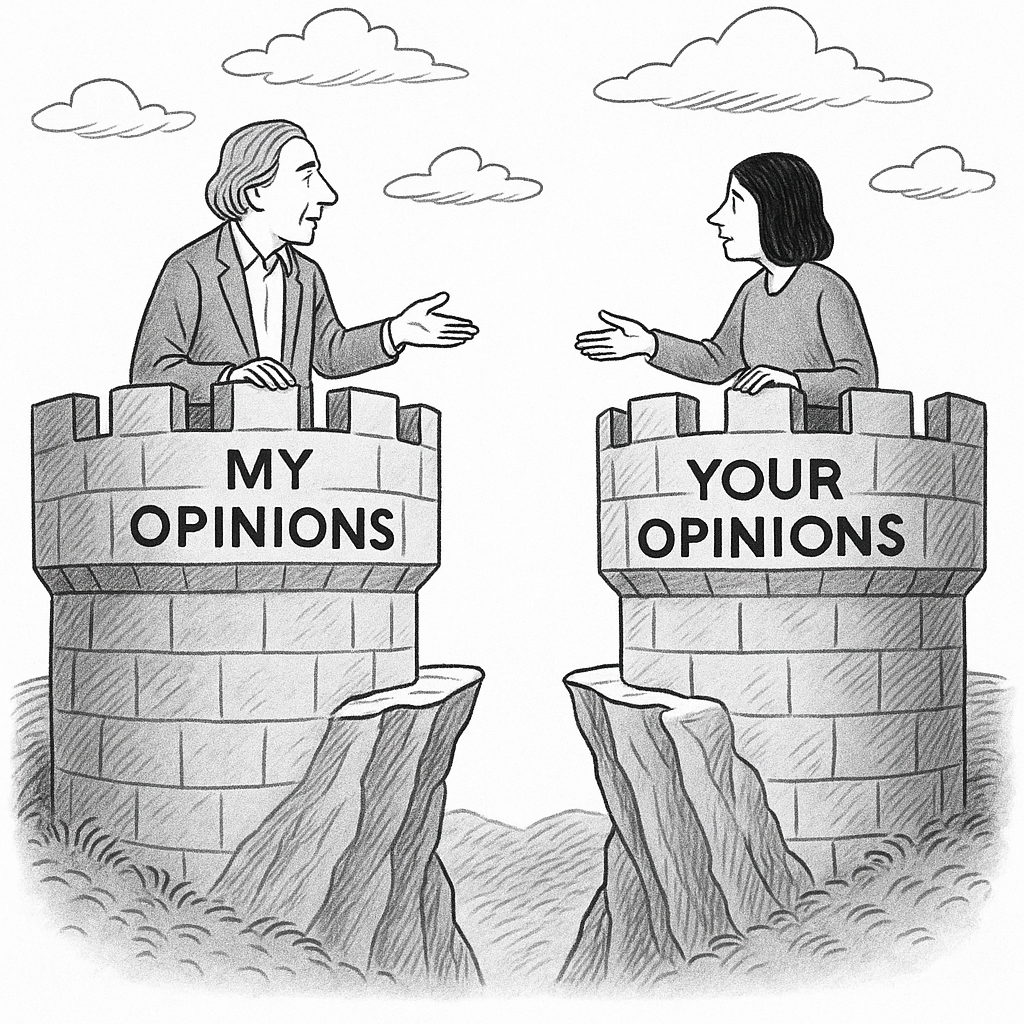
Suspending claims to possession thus transforms vulnerability into a resource. Where it exposes us, it enriches us; where it disarms us, it makes us more capable of receiving. It overturns the logic of conflict: the one who “wins” is not the one who defends most skillfully, but the one who allows the other to enter without destroying what is already there. In this space, dialogue ceases to be a duel and becomes a place of co-creation, where identity is not lost but redefined.
3.3 The capacity to welcome what exceeds
Evental dialogue never leads to a perfectly controllable outcome. What happens between interlocutors always exceeds their initial intentions—a surplus that belonged to neither of them beforehand. This excess is not an accessory element but the very sign that a transformative event has taken place: what emerges no longer belongs solely to either participant but becomes something third, born in the space between them.
To welcome this excess means to give up treating dialogue as a functional mechanism that must yield a result proportional to the effort invested. This is difficult because it asks us to set aside immediate utility, to refrain from forcing the outcome back into what can be calculated.
What moves us in this direction is the rare but decisive experience of finding ourselves changed by an encounter we did not plan. The transformation that results is never fully reversible: what we have seen, heard, or understood cannot be un-seen, un-heard, or un-understood. It is the experience of a “before” and an “after.”
A striking example of this dynamic can be found in Mozartian dramaturgy. In the finale of Così fan tutte, with music by Wolfgang Amadeus Mozart and libretto by Lorenzo Da Ponte, the experiment designed by Don Alfonso to prove female infidelity comes to an end. Throughout the opera, two young officers, Ferrando and Guglielmo, have tested their fiancées, Fiordiligi and Dorabella, by pretending to leave for war and then returning in disguise to court each other’s beloved. After initial resistance, the women yield, and the game grows serious. At the end, the deception is revealed, and the couples are reunited.
But the happy ending is not a simple restoration of the initial order. Mutual forgiveness is tinged with unease: what happened has exposed fragilities, desires, and possibilities that can no longer be ignored. The final chorus says it openly: “Fortunato l’uom che prende / ogni cosa pel buon verso, / e tra i casi e le vicende / da ragion guidar si fa” (Finale II). What is celebrated is not the return to some untouched order, but the acceptance that life is made of “cases and occurrences,” of unpredictability to be integrated, not erased. This acceptance marks a true transformative passage: from a mere rebalancing of the initial order to a new awareness that inaugurates a different way of being in relation.
To welcome what exceeds is to acknowledge that the encounter was not in vain, even if it hurt us, and that the truth emerging from it no longer belongs only to the parties but to a shared dimension. It is a choice not to neutralize the surplus of meaning that dialogue produces, not to reduce the new to a disturbance to be normalized. It means, instead, making use of it—letting it reshape our criteria of judgment and our way of being in the world.
Only in this way does dialogue become generative: because what is born is not a compromise between preexisting positions but an unprecedented shared ground that redefines the identities of the interlocutors and their future.
4. Generative change
After exploring the dimensions of generative dialogue, we can recognize that one of the fundamental characteristics of authentic and effective change is its capacity to make room for what has not yet appeared.
Speaking of the unforeseen means acknowledging that there are forms of change that cannot be predicted with precision. If something can be entirely calculated, then it is not truly new but only a variation of what is already known. The unforeseen, by contrast, can only be sensed within a limited margin of probability; beyond that margin, it occurs as an unplanned event, exceeding any predictive model. It is the moment when the unexpected breaks in and forces a reconsideration of the very framework of reference itself, not merely of the contents placed within it.
Generative change does not simply adjust means to pre-established ends. It opens new spaces, creates new configurations, and calls into question the very assumptions that had been taken for granted. Consider, for example, a conversation within a family. A discussion between a parent and an adolescent child may begin as a negotiation about rules and limits, but at a certain point, thanks to an unexpected word or a gesture that breaks the pattern, it may become the occasion for the parent to rethink their own role, shifting from a position of control to one of dialogue. What happens here is not a compromise but a transformation of the relationship itself: a new way of understanding emerges, one that could not have been foreseen. This is precisely the nature of generative change, which can be defined as the unprecedented carving out its own space.
Tweet
Generative change begins where calculation ends. The unforeseen breaks into the predictable, opening new spaces of meaning. It’s not adaptation, but transformation: the event that reshapes the very framework we thought unshakable. #dialogue #change #evental
To grasp this distinction more clearly, we might say that instrumental change operates within the realm of the predictable. It is a type of change that can be calculated, estimated, and planned, producing at most controlled surprises. Generative change, on the other hand, happens beyond the margin of the calculable: it is the irruption of the unforeseen that forces us to rethink the entire frame of reference. In this sense, it has an evental nature: it cannot be reduced to a technical sequence of steps but occurs as an event that transforms the participants themselves.
When linked to communicative interaction, such change does not arise from technical procedures (as in a vehicular conception) nor from a mere adjustment of interests (as in negotiation). The unforeseen becomes possible only within an authentic “evental” dialogue. Ultimately, instrumental change belongs to the logic of maintenance, while generative change belongs to the logic of creation. The first keeps a system alive by adapting it to its contingent problems; the second opens new spaces, generates possibilities that did not previously exist, and redefines the boundaries of what is possible. Only evental dialogue, with its openness to contingency, its suspension of possessive claims, and its capacity to welcome excess, can make this second kind of change possible.
5. Dialogue that reinvents the possible
At this point, the question becomes inevitable: how can we foster transformative dialogue, the kind that does not simply remove technical obstacles or seek negotiated compromises but opens new spaces of meaning and makes generative change possible? The answer cannot be reduced to a checklist of communication skills. Evental dialogue does not arise from applying procedures but from a willingness to move through uncertainty, to accept contingency, to let something unexpected transform us. This willingness requires inner training, almost a spiritual exercise: recognizing one’s own automatisms, suspending immediate reactivity, and tolerating the risk of questioning what seemed untouchable only moments before.
To understand the nature of this leap, it is worth recalling an episode recounted by Paul Watzlawick[4], dating back to the fourteenth century. During a prolonged siege, the commander of Hochosterwitz Castle, in Carinthia, Austria, found himself with supplies nearly exhausted: only one cow and a handful of grain remained. According to any logic of survival, he should have carefully preserved that last resource to prolong resistance. Instead, he did the opposite: he filled the cow with the grain, slaughtered it, and threw it over the walls in plain sight of the besiegers. The message was clear and unsettling: “We have plenty, we can resist for a long time.” Convinced of the futility of continuing, the besiegers withdrew.
This paradoxical gesture is far more than an anecdote; it is a true lesson in second-order change. It does not adjust a variable inside the system—does not prolong the siege, does not ration resources—but overturns the entire logic of the game. Instead of continuing to play by the rules of the siege, it invents new ones. It is the narrative equivalent of what I have called evental dialogue in this essay: an act that interrupts repetition and introduces an unprecedented element that no one had anticipated.
Applying this insight to dialogue means creating contexts in which it is possible to make “asymmetric,” unpredictable moves. In a work team, this might mean allowing moments in which nothing immediately useful is produced but voices are allowed to emerge freely, even at the cost of disrupting the agenda. In personal relationships, it means giving up the urge to control the outcome of every conversation and allowing the other to surprise us. At the institutional level, it means tolerating conflict and disagreement as spaces where meaning is generated rather than failures to be quickly repaired.
This perspective requires tending to the relational environment, protecting it from the excess of metrics and procedures that sterilize the unforeseen, and cultivating decentered listening—the kind Hans-Georg Gadamer describes as being carried into another horizon of meaning. It also means considering conflict as a privileged site for the emergence of the new. Second-order change occurs precisely when one party is willing to take a step outside the logic of opposition, breaking its structure.
Tweet
Transformative dialogue isn’t born from procedures but from risking the unexpected. Like the commander who threw the cow beyond the walls, it overturns the game’s logic, opening space for the unforeseen and for new shared meanings to emerge. #dialogue #change #evental
None of this can ever be guaranteed, because generative dialogue remains an event, not a protocol. But what we can do is create the conditions for it to happen: leaving open spaces, unsaturated times, opportunities for speech not bound to predetermined outcomes. When it occurs, the result is not a compromise but a new beginning, an “unprecedented carving out its own space,” capable of transforming not only the contents of the discussion but the identities of the participants themselves.
The story of the cow of Hochosterwitz leaves us with a striking image: a gesture that overturns established logics, transforms scarcity into symbolic abundance, and turns apparent loss into the condition for unexpected salvation. It is an image that interrogates our way of understanding dialogue and change. It asks whether we are willing to “throw our cow” beyond the walls of our certainties.
The path we have traced—from the most technical and instrumental models to generative dialogue—is not merely a theoretical progression. It maps a tension running through all our communicative experiences: the tension between the need for control and the possibility of transformation, between the safety of what is already known and the risk of the unprecedented. We live this tension daily, in both professional and intimate relationships, in institutional contexts as well as informal spaces.
The strongest temptation is to reduce dialogue to communicative technology, to a protocol to be optimized, to a negotiation to be managed. It is understandable: in a world that demands efficiency and measurable outcomes, evental dialogue can seem like a luxury we cannot afford. And yet, it is precisely when we fully give in to this temptation that we discover the paradox. The more we try to control the outcomes of dialogue, the less capable it becomes of generating something new; the more we reduce it to a tool, the less it can touch what truly matters in our lives.
The lesson of the cow reminds us that true change does not happen through gradual accumulation but through a qualitative leap. It is not a matter of constantly adding new communication techniques to our repertoire, but of being willing, at crucial moments, to risk everything—even that last resource we thought we needed to protect. It is in this seemingly irrational gesture that space opens for the unforeseen, for that excess of meaning that none of the participants in the dialogue possessed beforehand.
But this is not about romanticizing uncertainty or celebrating risk uncritically. The commander of Hochosterwitz did not act out of blind desperation but with a paradoxical lucidity that turned necessity into creativity. Likewise, generative dialogue is not an abandonment to chance but a higher form of rigor: the kind that recognizes when it is time to suspend the usual rules to allow something new to emerge.
In an age marked by growing polarization, seemingly irreconcilable misunderstandings, and conflicts that appear destined to perpetuate themselves, the capacity to generate transformative dialogues is not a philosophical luxury but a vital necessity. Not to erase differences in artificial consensus, but to allow something no one had foreseen to emerge from them: an unprecedented common ground, a possibility of future that did not previously exist. Just as the cow, thrown beyond the walls, changed the fate of a siege, so authentic dialogue can still surprise us, transforming what seemed lost into a shared possibility of salvation.
References
Scarafile, Giovanni. La spina nella carne. Cinque lezioni sul dialogo. YOD Institute, 2024.
Schein, Edgar H. «On Dialogue, Culture, and Organizational Learning». Organizational Dynamics 22, fasc. 2 (1993): 40–51. https://doi.org/10.1016/0090-2616(93)90052-3.
Shannon, Claude Elwood, e Warren Weaver. The mathematical theory of communication. University of Illinois Press, 1998.
Watzlawick, Paul, John H. Weakland, e Richard Fisch. Change; principles of problem formation and problem resolution. 1st ed. Norton, 1974.
[1] Schein, «On Dialogue, Culture, and Organizational Learning».
[2] Shannon e Weaver, The mathematical theory of communication.
[3] To describe this attitude, in my book La spina nella carne. Cinque lezioni sul dialogo (YOD Institute, 2024, forthcoming in English), I used the expression “homo muniens.” This term designates an anthropological figure that portrays the human being as one who “equips” himself, meaning someone who arms and prepares himself with tools of protection, defense, and organization of his world. Unlike homo faber, defined by productive capacity, homo muniens is defined by the ability to build safeguards, draw boundaries, and create conditions of inhabitable space. It is a paradigm that highlights the preventive and strategic dimension of human action: protecting what is fragile, ensuring the continuity of what is considered essential, and anticipating the risk of chaos. From this perspective, dialogue itself can be understood as a form of symbolic fortification, a way of creating protected spaces in which speech can circulate without degenerating into destructive conflict.
[4] Watzlawick et al., Change; principles of problem formation and problem resolution.

 Esercizi di vita desta