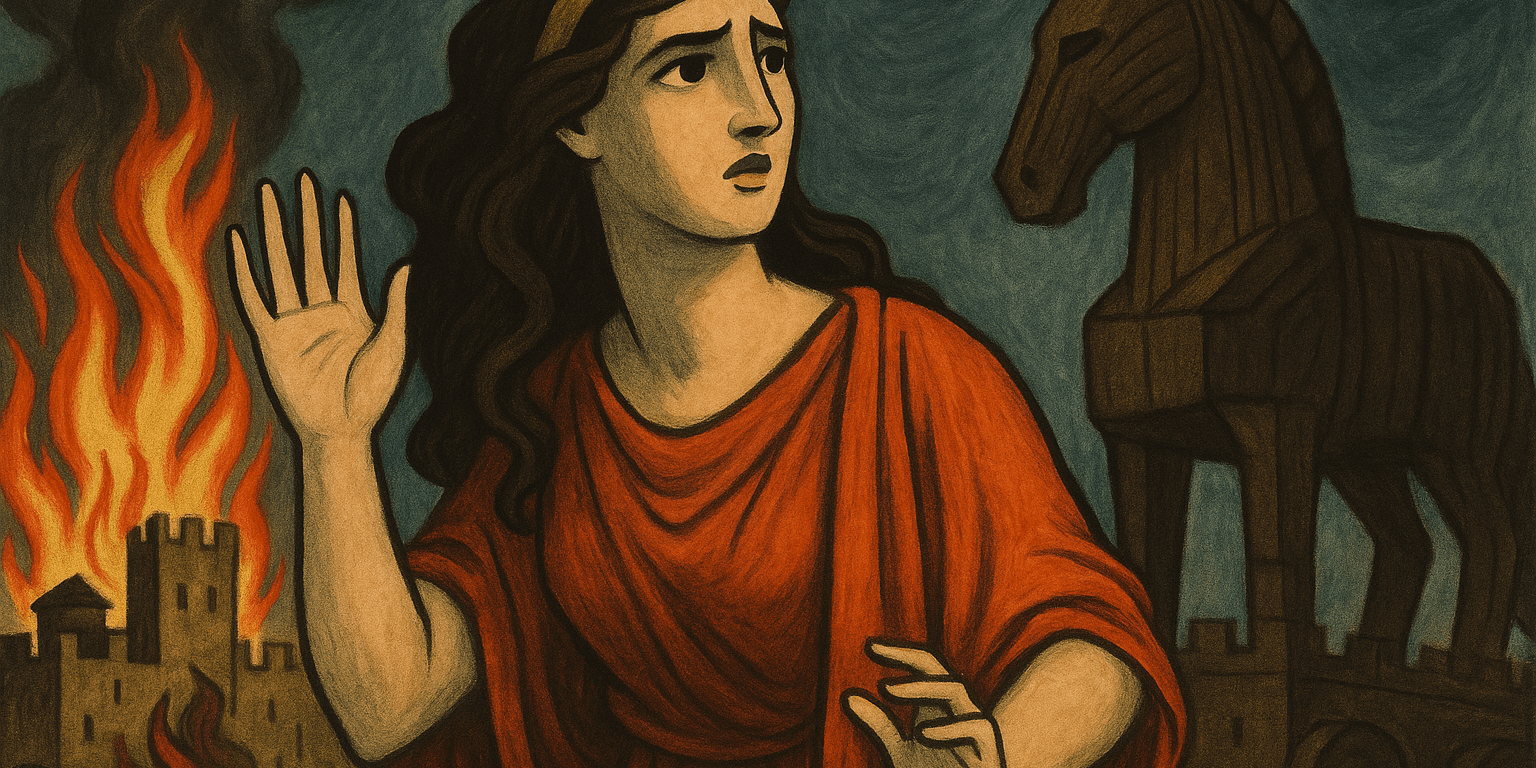
«What is to come, will come. Soon thou, present here thyself, shalt of thy pity pronounce me all too true a prophetess»[1]. When, in Aeschylus’ Agamemnon, Cassandra utters these words, the tragedy has already unfolded. The prophetess perceives with searing clarity what others refuse to acknowledge: the imminent ruin of Troy, the deceit concealed within the wooden horse, the death approaching under the guise of a gift. Yet her voice, laden with truth, falls into emptiness; her cry disperses into the indifference of those who will not listen. In that gesture of rejection, in that deliberate deafness, the destiny of not merely a city but of an entire civilization is fulfilled.
Across the centuries, Cassandra’s figure continues to speak to us with renewed urgency. She is no longer only the Trojan seer announcing destruction; she becomes the very emblem of our age—an age in which the Earth itself, like Cassandra, sends us messages we can no longer decipher, echoes of a catastrophe already under way. Her prophecies are no longer voiced by human mouths but by the rising seas, the melting glaciers, and the burning forests. Yet, like the Trojans of old, we remain deaf, enveloped in the noise of our convictions, unable to hear what exceeds our accustomed frames of understanding.
We inhabit the Anthropocene, the epoch in which the human being has become a geological force capable of altering the planet’s fate irreversibly. What is most disturbing is not the material magnitude of this power but its companion loss of sensitivity—an almost structural incapacity to listen. At the very moment we have attained maximal power, we seem to have lost the faculty of response. The crisis we face is therefore not solely ecological; it is communicative—a crisis of listening itself. We have fashioned a world in which speech no longer serves understanding but domination, where communication has become competition and listening a mere social courtesy devoid of depth. Our hyperconnected yet isolated societies generate a constant noise in which every voice overlaps the next until all are annulled. The result is a relational desert: people speak without meeting, nations observe one another without understanding, and the Earth—living organism, web of relations and exchanges—returns to us a silence thick with signals we can no longer interpret.
When we imagine environmental crisis, we picture visible disasters: deforestation, pollution, the extinction of species. Yet behind these images lies a subtler wound—one that concerns how we perceive and communicate with the world we inhabit. We have forgotten how to read the signs the Earth sends us, not because they are obscure, but because we have unlearned how to translate them into language, how to recognize them as part of a shared discourse. Each storm, each drought, each fire is a message demanding attention; but we, trained in a language that measures and calculates, can no longer hear what lies beyond our categories of utility.
From this incapacity arises what might be called unheardalgia—the pain of unheardness. It is the pain of those who speak without being believed, but also of those who can no longer hear another’s voice. It is the wound of a planet communicating its own suffering, and of a humanity that, though it knows, no longer feels.
To emerge from this condition, it is not enough to refine our communicative techniques; we must rethink communication itself. Western thought has long grounded dialogue in symmetry—the sharing of a common language and agreed rules. Yet authentic dialogue arises from asymmetry, from the encounter with what resists immediate comprehension. It is in this light that dialogetics must be understood: a practice of listening that does not presuppose perfect understanding but accepts difference as the very condition of any possible meaning. Dialogetics teaches that dialogue is not a harmonious act but a risky, fragile gesture that exposes one to vulnerability and openness. It does not seek victory but resonance. Applied to our relationship with nature, it demands a radical shift—from the language of imposition to that of listening, from the desire to dominate to the desire to understand.
This means recognizing that the Earth is not an inert object but an interlocutor; that ecosystems communicate through networks of relations and signals; that trees, seas, currents, and winds speak a language we can learn only if we relinquish the presumption of being the sole bearers of meaning.
From this perceptual revolution arises the notion of a pathic humanism. The term pathic, derived from pathos, denotes not sentimental weakness but the capacity to be affected, to resonate with what is other than oneself.
Pathic humanism is not an anti-humanism but a re-envisioned humanism grounded in permeability. It does not celebrate humanity’s centrality as dominator but affirms its dignity as custodian. It rests not on the power of control but on the responsibility of relation. For centuries we have equated knowing with separating, analyzing, measuring; we have confused knowledge with conquest and understanding with possession. We are now beginning to see that the deepest intelligence lies not in detachment but in participation, not in critical distance but in the capacity to feel.
Pathic humanism calls for a new mode of knowledge—a pathic reason that unites rigour with compassion, analysis with care, science with attentiveness. It is a form of knowing that does not abandon lucidity but accompanies it with empathy, recognizing that every relation—human, animal, or natural—is both fragile and precious.
Listening, in this sense, is not a passive act but a political and transformative one. It means creating the conditions for other voices—human and non-human—to emerge and be acknowledged. The challenge of the Anthropocene is not only technological but narrative: we must reinvent the languages through which we tell the story of the Earth, restoring speech to what we have rendered mute.
At the close of the tragedy, Cassandra enters Agamemnon’s palace knowing she will not be believed. Yet she speaks to the end, for speech, even when unheard, remains an act of truth.
So too the Earth continues to speak, even when we fail to comprehend. Unlike Troy, however, we still have a chance: we can reverse Cassandra’s curse. We can learn to listen, to restore attention to what we have relegated to mere background. Perhaps the most urgent task of our time is precisely this—to recover the capacity to hear, to perceive, to feel. Not out of fear of catastrophe, but out of love for the world. For every unheard word becomes fate, and every act of genuine listening may yet become a beginning.
(The Italian version of this article was published in the daily newspaper Avvenire on November 15, 2025.).
[1] Smyth, H. W. (1926). Aeschylus: Agamemnon / Libation-Bearers / Eumenides (English translation). London & New York: William Heinemann & G. P. Putnam’s Sons, p. 109.

 Esercizi di vita desta