
Giovanni Scarafile, Yen-Yi Lee
Nor did I think your edict had such force / that you, a mere mortal, could override the gods,/ the great unwritten, unshakable traditions”. (Sophocles, Antigone, ll. 453–455, tr. R. Fagles).
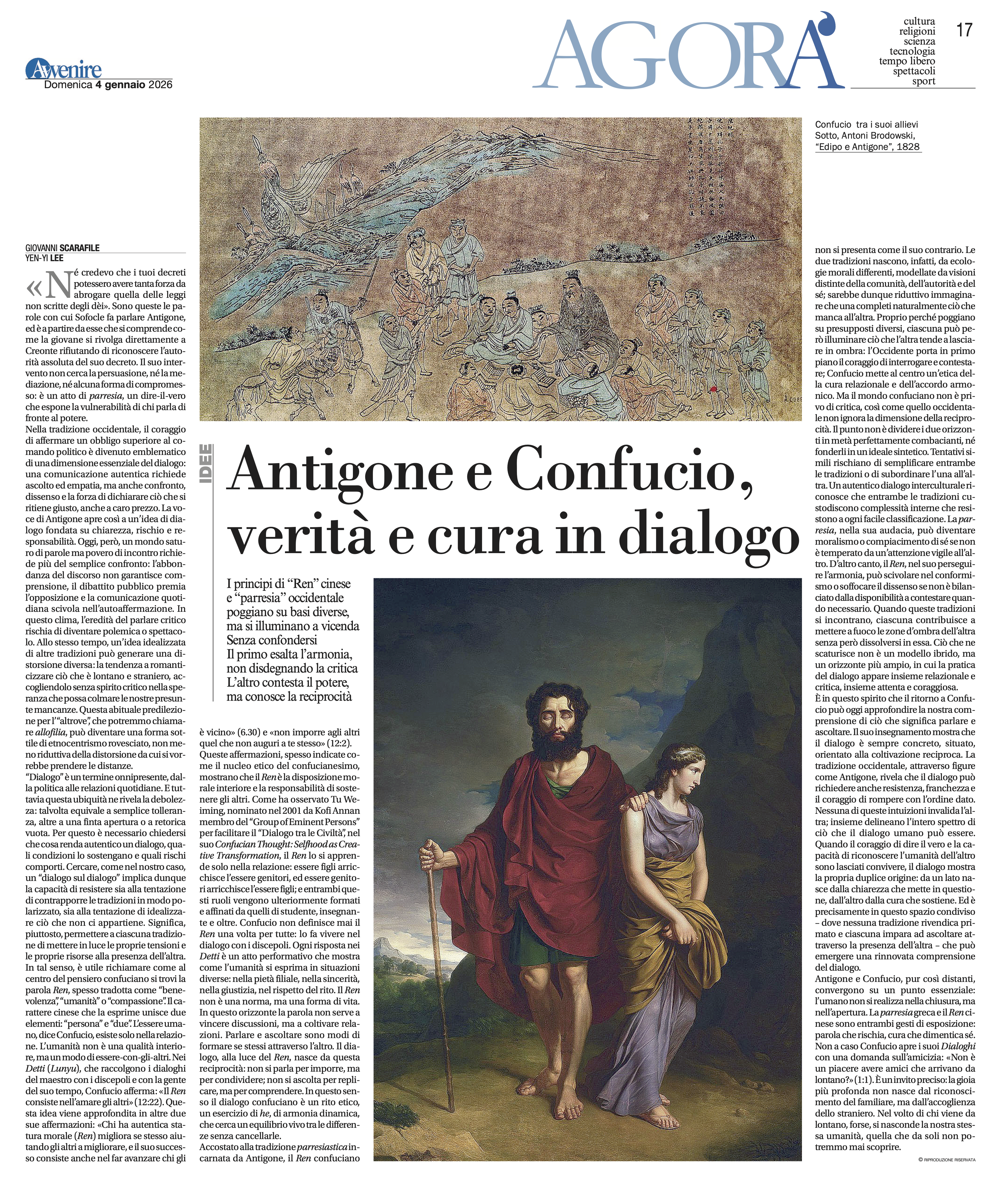
With these words, Antigone addresses Creon directly, refusing to recognize the absolute authority of his decree. Her speech does not aim at persuasion, negotiation, or compromise; it is an act of parrhesia, a truth-telling that exposes the vulnerability of the speaker before power. In the Western tradition, this courage to articulate a higher obligation in the face of political command has come to exemplify a central dimension of dialogue: the possibility that genuine communication requires not only listening and empathy, but also the willingness to confront, to dissent, and to articulate what one holds to be right even at great personal cost. Antigone’s voice, firm yet fragile, sets the stage for a conception of dialogue that is born from clarity, risk, and responsibility—an understanding that continues to shape Western reflections on speaking together in the public realm.
Yet our world today, saturated with words yet poor in genuine encounter, demands more than confrontation. The proliferation of speech does not automatically yield understanding; public debate often valorizes opposition for its own sake, while everyday communication gravitates toward self-assertion. In such a climate, the Western legacy of critical speech risks being reduced either to polemic or to spectacle. Conversely, an idealized view of other traditions can lead to a different distortion: the inclination to romanticize what is distant and foreign, adopting it uncritically in the hope that it may compensate for our perceived shortcomings. This habitual preference for the “elsewhere,” which we might call allophilia, can be a subtle form of reverse ethnocentrism, no less reductive than the ethnocentrism it seeks to escape.
“Dialogue” is an omnipresent term, from politics to everyday relationships. Yet this very ubiquity reveals its weakness: at times it amounts to mere tolerance, at others to a false openness or empty rhetoric. This is why we must ask what makes a dialogue genuine, what conditions support it, and what risks it entails.
To seek a dialogue on dialogue therefore requires resisting both the temptation to polarize traditions and the temptation to idealize what is not our own. It means instead allowing each tradition to illuminate its own tensions and resources in the presence of the other.
At the heart of Confucian thought lies the word Ren, often translated as “benevolence,” “humanity,” or “compassion.” The Chinese character for Ren unites two elements: “person” and “two”. The human being, Confucius tells us, exists only in relation. Humanity is not an inner quality, but a way of being-with.
In the Lunyu, known as the Analects, the recorded sayings and dialogues between him, his disciples, and the people of his time, Confucius declares “Ren consists in loving others” (Analects 12: 22). This idea is further elaborated in his two sayings, “The person of Ren wishes to establish himself by helping others to establish themselves; he wishes to realize himself by helping others to realize themselves”. (Analects 6:30) and “Do not impose on others what you do not wish for yourself.” (Analects 12:2)
These sentences, often cited as the ethical core of Confucianism, show that Ren is one’s inner moral disposition and responsibility to support others. As Tu Wei-ming, nominated in 2001 by Kofi Annan as a member of the United Nations “Group of Eminent Persons” to facilitate the “Dialogue among Civilizations”, has indicated in his Confucian Thought: Selfhood as Creative Transformation (SUNY, 1985), one learns this relationally: being a son or daughter enriches being a parent, and being a parent enriches being a child; both are further informed and cultivated by one’s roles as student, teacher, and beyond.
Confucius never defines Ren once and for all: he brings it to life through dialogue with his disciples. Each response in the Analects is a performative act showing how humanity is expressed in different situations—in filial piety, sincerity, justice, respect for ritual. Ren is not a rule, but a form of life.
Within this horizon, speech does not serve to win arguments; it serves to cultivate relationships. Speaking and listening are ways of cultivating oneself through the other.
Dialogue, in the light of Ren, arises from this reciprocity: one does not speak to impose, but to share; one does not listen to react, but to understand. In this sense, Confucian dialogue is an ethical rite, an exercise in harmony (he), seeking dynamic balance among differences without erasing them.
Placed beside the parrhesiastic tradition embodied by Antigone or Socrates, Confucian Ren does not stand as its opposite. The two traditions arise from different moral ecologies, shaped by distinct visions of community, authority, and the self, and it would be reductive to imagine that one naturally complements or completes the other. Yet it is precisely because they begin from different assumptions that each can illuminate what the other tends to leave in shadow: the West foregrounds the courage to question and contest; Confucius highlights the ethic of relational care and attunement. But the Confucian world is not without critique, nor is the Western world without concern for mutuality. The point is not to divide them into neatly matched halves, nor to fuse them in a synthetic ideal. Such moves risk simplifying both traditions or subordinating one to the other.
Instead, a genuine cross-cultural dialogue acknowledges that both traditions contain internal complexities that resist easy categorization. Parrhesia, in its boldness, can become moralism or self-righteousness unless tempered by attentiveness to others. Ren, in its pursuit of harmony, can slip into conformity or suppression of dissent unless balanced by the willingness to challenge. When these traditions meet, each helps clarify the blind spots of the other without dissolving into it. What emerges is not a hybrid model, but a more expansive horizon in which the practice of dialogue is understood as both relational and critical, both caring and courageous.
It is in this spirit that returning to Confucius today can deepen our understanding of what it means to speak and listen. His teaching shows that dialogue is always concrete, always situated, always oriented toward mutual cultivation. The Western tradition, through figures such as Antigone, reveals that dialogue may also require resistance, truth-telling, and the courage to break with a given order. Neither insight invalidates the other; together, they mark the full range of what human dialogue can be.
When the courage to speak truth and the willingness to attend to the humanity of others are allowed to coexist, dialogue reveals its double origin: one part rises from the clarity that challenges, the other from the care that sustains. It is precisely in this shared space—where neither tradition claims precedence, and where each learns to listen through the presence of the other—that a renewed understanding of dialogue can emerge.
Antigone and Confucius, distant as they are, converge on one essential point: the human is not fulfilled in closure, but in openness. Greek parrhesia and Chinese Ren are both gestures of exposure — a word that risks, a care that forgets itself.
It is no coincidence that Confucius opens the Analects with a question about friendship: “Is it not joyful to have friends coming from afar?” (1:1). It is a precise invitation: the deepest joy does not come from recognizing what is familiar, but from welcoming what is foreign. In the face of the one who comes from afar, our own humanity may be concealed — a humanity we could never discover on our own.
This article was originally published in the Italian newspaper Avvenire on January 4, 2026.

 Esercizi di vita desta