
The word “restanza” isn’t in most dictionaries. It doesn’t appear in headlines or policy papers. And yet, for many people—especially those living in places often dismissed as peripheral—it captures something essential. It speaks to the experience of staying not as resignation, but as choice. Of building something where others see absence. Of creating presence in the face of decline. This essay explores what it means to stay when staying is neither passive nor static, but a form of action, imagination, and quiet courage.
In recent years, the Italian word restanza—roughly translatable as “remaining,” though the English lacks its depth—has gained renewed traction, thanks largely to the work of anthropologist Vito Teti. For Teti, restanza is more than a geographical condition; it is a way of inhabiting displacement, of turning rootedness into a form of resistance. In his hands, the word becomes a key to understanding the tension between belonging and dislocation, between staying put and staying open.
But the spirit of restanza predates its naming. You can feel its pulse in the works of Ernesto de Martino, Corrado Alvaro, Franco Arminio. Franco Cassano’s idea of pensiero meridiano (2021) —a southern way of thinking that moves slowly and sees far—offers something strikingly similar. These thinkers, in different ways, return dignity and centrality to what the dominant narrative has long dismissed as peripheral.
Its roots go deeper still. In medieval monastic life, the principle of stabilitas loci—the commitment to remain in one place—was not about inertia but transformation. The refusal to wander was not a rejection of movement; it was the precondition for the most radical of all journeys: the inward one, toward God. Even then, staying was never only staying. It was also a kind of going—into depth, into silence, into responsibility.
Teti offers two definitions that clarify the paradoxical nature of restanza. The first: “To truly stay, one must walk, must travel through the invisible margins” (Teti 2022, p.7). The second: “The essence of staying lies in feeling exiled” (Teti 2022, p. 58). These aren’t contradictions to resolve, but tensions to inhabit. To stay is not to choose between leaving and remaining, but to hold both gestures at once. It means to root oneself in a place without possessing it, to endure distance from within proximity.
Elsewhere, and not in formal theory, you might hear the phrase liminoid anxiety (Turner 1977; Thomassen 2014) —a loosely defined term used to describe the unease of inhabiting thresholds. It hasn’t entered academic canon, nor is it tied to a single theoretical school. But it names something real: the discomfort that arises when one’s identity is neither fully settled nor fully undone, when categories fail and nothing stable is on offer. The feeling is more widespread than one might think. It surfaces at those moments in life—messy, transitory, unstructured—when you’re no longer who you were, and not yet who you’ll be.
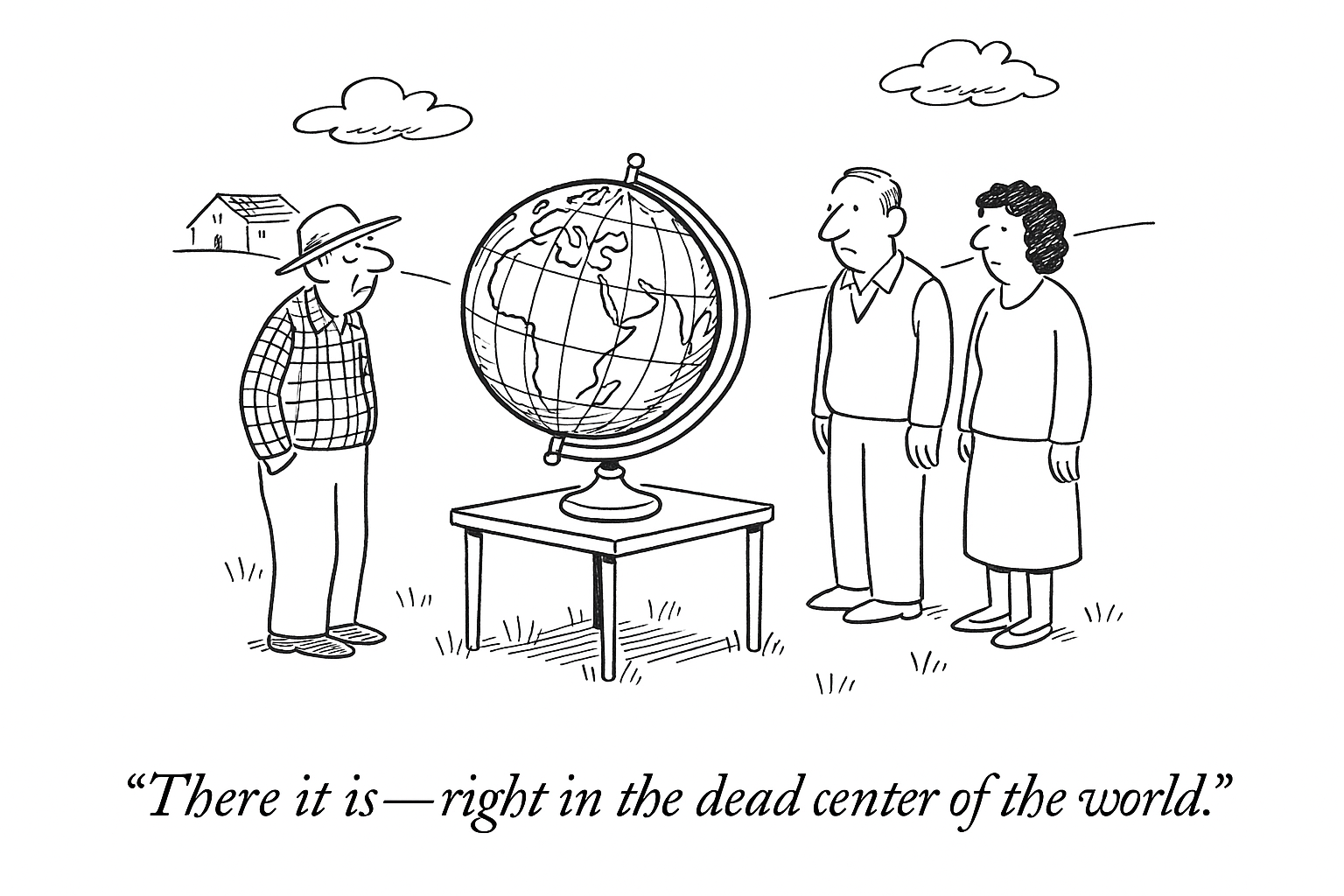
Within this frame, the person who practices restanza begins to seem unsettling. They violate one of our most deeply held cognitive habits: the need for clear placement. Are you a traveler or a local? An innovator or a traditionalist? Global or rooted? Our minds prefer their opposites neatly arranged. Restanza disrupts that order. It’s an identity that won’t resolve, a figure that doesn’t fold easily into categories.
And this isn’t just an abstract dilemma. From the beginning, we’re trained to sort the world through oppositional pairs: good/bad, right/wrong, in/out. What emerges is what might be called a “binary mind,” one shaped by dichotomies, useful for organizing thought but clumsy when dealing with experience. The Aristotelian principle of non-contradiction—something can’t be and not be at the same time—has filtered into our culture more thoroughly than we tend to realize.
Yet those who stay without being static, who depart without leaving, who live at the edge without being marginal, unsettle that framework. They introduce cognitive friction. They don’t quite compute. And as with many things we can’t classify, the result is suspicion. Some see their refusal to commit to one camp or another as evasive or indecisive. Others see it as a privilege—the luxury of not having to choose in a world that demands choices.
This mental structure—so deeply internalized—has come to shape the decisions we make. You either study or you work. You stay or you leave. You win or you lose. But real life is messier. Is a working mother wholly mother or wholly professional? Is an artist who teaches any less a creator? In agriculture, there’s a practice known as grafting: a healthy branch is inserted into an older trunk, giving new life to what seemed spent. It’s not about replacing, but joining. The farmer does not choose between continuity and change—he works with both. Restanza, in this sense, is a grafting of time, of place, of identity. It’s not either/or. It’s both, held with care.
So restanza, far from being a retreat, becomes a way of inhabiting reality without oversimplifying it. To stay is not to shut the world out. To leave is not to abandon one’s ground. One move makes the other possible. One enriches the other. It’s a way of living in-between—not as a failure of resolve, but as a quiet discipline.
Those who live this way do not avoid thresholds—they pass through them, reshape them. They don’t deny contradiction—they turn it into creativity. In that sense, restanza is not just a gesture, but a stance. Not only an individual path, but a model for belonging in an age that no longer offers stable maps.
We live in a culture that celebrates movement, ambition, disruption. But perhaps what we need, now more than ever, is a renewed art of staying—not as withdrawal, but as commitment. Restanza invites us to slow down, to pay attention, to recognize the generative force of those who remain—not because they have no choice, but because they believe that even silence can speak, that even small gestures can hold the weight of meaning. In that stillness, there is not inertia, but direction. And maybe even hope.
References
F. Cassano, Il pensiero meridiano, Laterza, Bari-Roma 2021.
V. Teti, La restanza, Einaudi, Torino 2022.
B. Thomassen, Liminality and the Modern: Living Through the In-Between, Routledge, 2018.
V. Turner, The Ritual Process: Structure and Anti-Structure, Cornell University Press, 1977.
—
This text is based on a lecture delivered in Latiano (Brindisi), on December 14, 2014, titled:
“Abitare la comunità, custodire l’umano: il personalismo della restanza in Gilberto de Nitto”.

 Esercizi di vita desta