
At first glance, the question seems almost unnecessary. We live in an age that worships individuality, celebrates diversity, and prizes authenticity. Everywhere we turn, the rhetoric is about breaking molds and living “your truth.” And yet, it’s precisely in this era of self-proclaimed autonomy that conformity has slipped into the bloodstream of everyday life, stealthy and invisible, shaping our gestures, our language, our moral judgments, even our shared emotions.
In Alessandro Manzoni’s The Betrothed, Don Abbondio embodies the type. He isn’t a villain or a tyrant. He knows what justice demands, but he bows before power. His retreat is not born of malice but of fear—a fear of trouble, of standing out, of putting himself at risk. That kind of conformity, grounded less in hatred than in cowardice, ends up serving the interests of the powerful.

Never have we heard so many calls to “be yourself,” and never has public life been so marked by an unspoken demand to align, to use the same words, express the same outrage, smile in the same way. Freedom is loudly proclaimed, while the actual space for dissent grows narrower.
Tweet
We celebrate being “authentic,” yet live in the copy-paste culture of opinions.
No censors are required. No threats of violence. Conformity thrives on subtler cues: the sudden chill in an office when someone voices an unapproved thought, the stilted silence at a dinner table when a guest raises a taboo subject—war, rights, the body’s autonomy. Or, in our digital age, the eerie quiet when a social media post fails to match the dominant mood and is instantly scrolled past in favor of lighter, safer images.

The modern conformist is not devoid of ideas or words. On the contrary, he has a ready vocabulary, fluent access to the public conversation. But what he says is rarely the product of inner reflection. It’s more often a careful selection of already sanctioned formulas, opinions guaranteed not to provoke discomfort or isolation.
Philosopher Byung-Chul Han calls this the “hell of the same,” where difference itself is treated as disruption, and the pressure to align reaches into the most intimate recesses of thought. The surface harmony is deceptive. For when someone dares to dissent, conformists instinctively band together, deploying an unspoken conventio ad excludendum to isolate the outsider, to render their dissent ridiculous, excessive, or dangerous.
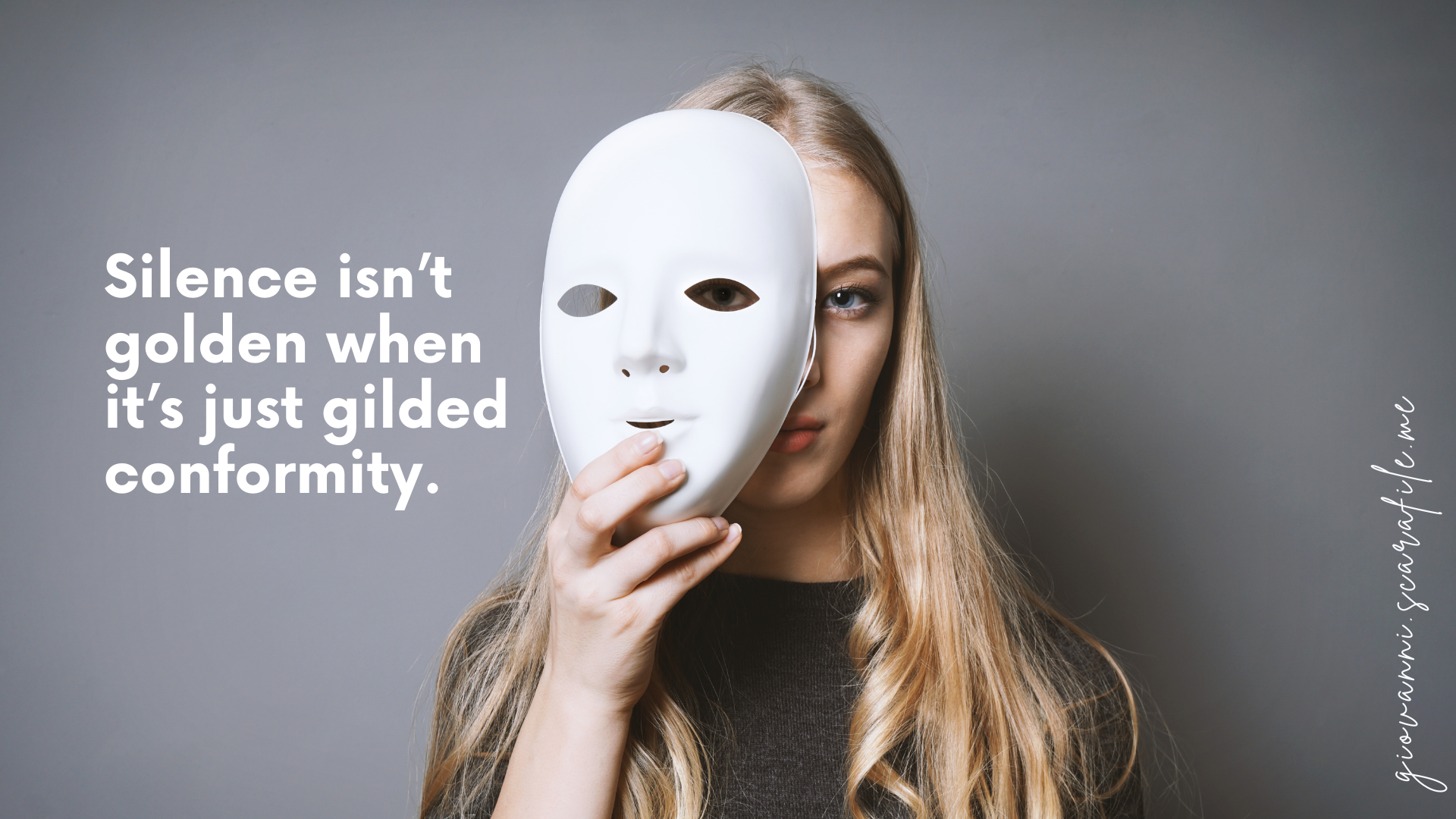
This is how caution hardens into silence. It’s not that people lose their voices; it’s that they train themselves never to use them in ways that might threaten belonging. The mechanism, disturbingly familiar, sustains larger systems of power: the cult of leaders, the theater of institutions reduced to hollow words, the rituals of flattery and exclusion. As Timothy Snyder warns in On Tyranny, “Most of the power of authoritarianism is freely given. Individuals offer themselves without being asked.” No regime needs to enforce silence when silence is willingly supplied.
And so the majority settles into the warm bath of consensus. Life there seems secure, full of polite exchanges and apparently solid ties. Yet beneath the surface lies a void—relationships stripped of depth, promises that carry no weight, friendships that amount to little more than insurance against exclusion.
A workplace worthy of the name should be the opposite: a space where difference is oxygen, where dissent sharpens judgment, where leaders see their role not as the center of gravity but as facilitators of multiple voices. Instead, old patterns of control persist, often under the naïve belief that they’ll remain invisible beyond the small communities where they’re enacted. But in today’s transparent world, every petty power play risks exposure, and once revealed, makes its architects look not authoritative but absurd.

The question remains: who will resist? Who will dare to say no when everything urges silence? To resist means to step outside the circle of safety, to risk loneliness. It means refusing the comfort of complicity, even when we call it “diplomacy” or “prudence.” In these times, the word no is not an act of rage or pointless provocation. It is a pledge of fidelity—to oneself and to others. It is the only way to preserve truth, responsibility, dignity.
Because in the end, when the noise fades and the lights go out, we will not measure our lives by the doors we kept open through prudence. We will ask ourselves how many times we had the courage to say no. And it is that solitary no, spoken against the grain of collective silence, that may be the only sound strong enough to save us from a world where even dignity can become a commodity.
Originally published in Avvenire on August 19, 2025.


 Esercizi di vita desta