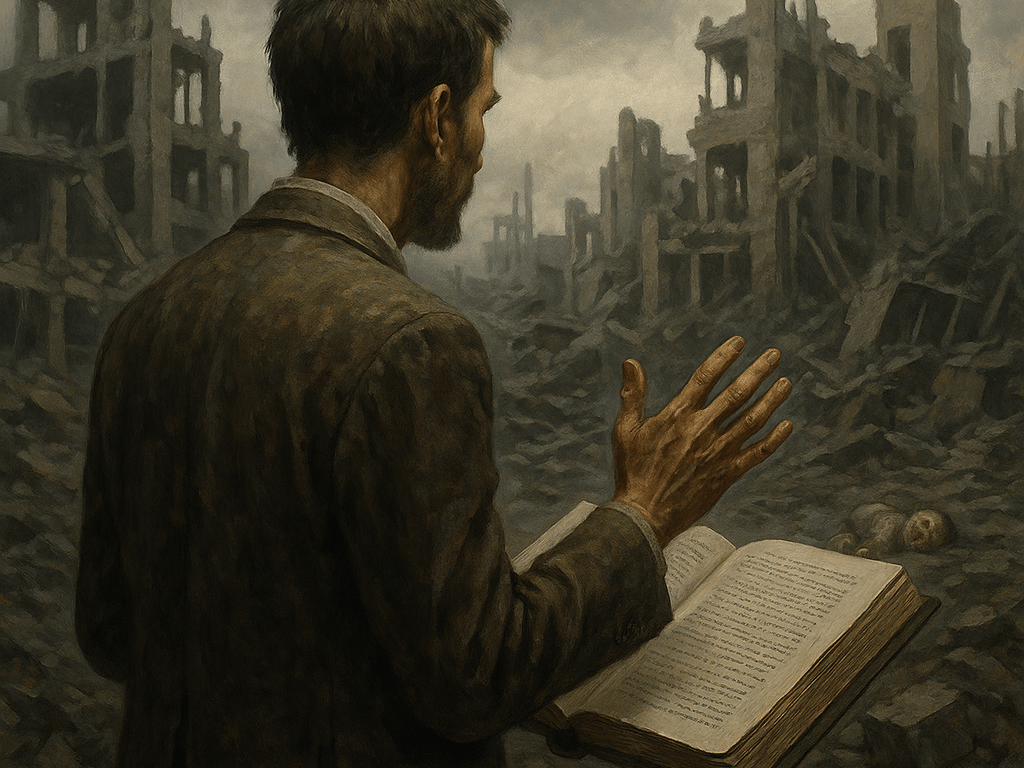
There are moments when language itself seems to break. Faced with images of children pulled from the rubble, of cities reduced to concrete skeletons, of lives erased with the cold precision of a statistic, we discover that the words we have used for centuries – tragedy, horror, barbarism – have become hollow shells. We have worn them out by repeating them, until they no longer hold meaning.
This is the cruelest trap: at the very moment when we most need to name evil in order to resist it, we find that our vocabulary is exhausted. “Genocide” becomes a hashtag. “Crime against humanity” a bureaucratic formula. Even “Never again” sounds like a promise betrayed too many times.
Albert Camus, in his prophetic 1949 speech The Time of the Assassins, identified this drift with surgical precision: “To heal Europe, to serve the future of the world, we must, for a time, set against the morality of murder this morality of dialogue.” The morality of murder is not only killing, but believing that silence enforced by force is stronger than words, that the other can be erased, that violence is the only possible grammar.
But what does it mean to choose dialogue when the other side is bombing hospitals? How do we speak with those who have already decided we do not exist? Here lies the painful paradox: the dialogue we need is not the negotiation between warring parties – that is often impossible, at least in the short term. It is rather a counterfactual reality, an act of resistance against the dominant logic. To engage in dialogue is to assert that a world is possible in which words weigh more than bullets, even when everything suggests otherwise.
Bearing witness thus becomes the most radical form of this impossible dialogue. The witness does not speak to the killer – that would be futile – but to an invisible third: the collective conscience, future generations, that part of humanity that can still choose. The witness says: “This is happening, I saw it, and by telling it I prevent it from becoming just a statistic.” It is not dialogue with the executioner but despite the executioner.
Tweet
When words break, what remains? If “genocide” is just a hashtag and “never again” a broken promise, maybe testimony is our last act of resistance — a way to say: this happened, and humanity is still possible.
Every act of true testimony creates a crack in the morality of murder. The doctor who documents the wounds he treats, the teacher who keeps teaching under bombardment, the journalist who writes down names instead of numbers – they all implicitly assert that another logic exists. They do not change immediate reality, but they keep open the possibility of a different future.
There is something tragically heroic about this. Choosing dialogue when force prevails is like planting seeds in a burned field. You do not know whether they will grow, but the very act of planting them is a declaration: this field will be fertile again, even if I will not live to see the harvest. It is a kind of secular faith in humanity.
Dialogue as counterfactual reality is therefore not political naivety. It is a long-term strategy. While the morality of murder produces only deserts – physical and moral – the morality of dialogue preserves the possibility of reconstruction. Even a silent dialogue, made of glances through the rubble, is worth more than a thousand victory proclamations.
And so we discover that to bear witness is already to engage in dialogue: with those who come after us, with those elsewhere facing the same horrors, with that part of ourselves that risks surrendering to cynicism. It is a dialogue that does not expect an immediate answer but stubbornly keeps asking questions. For as long as someone continues to ask, “How could this happen?”, the morality of murder has not entirely prevailed. In this thin space – fragile yet indestructible – the fate of our humanity is decided.

 Esercizi di vita desta