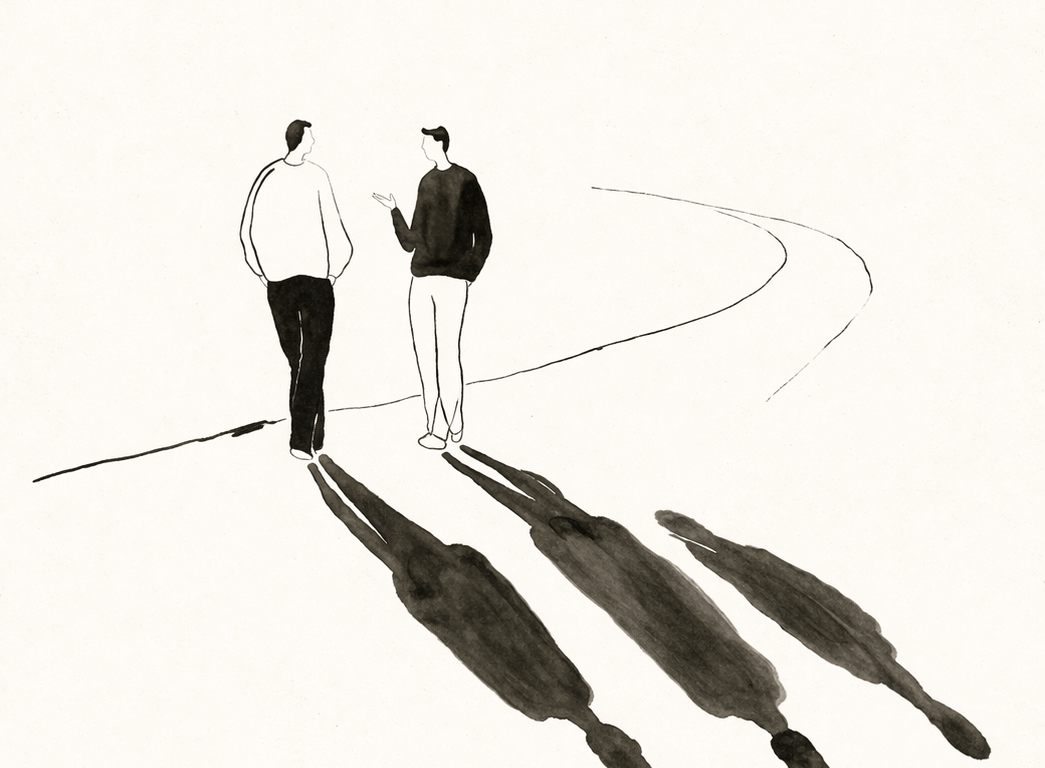
Two travelers walk along a road, talking. Their speech is not hesitant: it has the terrible compactness of something already closed. Each word confirms the previous one; each step presents itself as necessary—the meaning seems entirely available, leaving nothing but its unfolding. And yet, precisely here, within this fullness, something has already been lost. What governs them is not error, but a truth that has arrived too early, too solid to remain open to transformation. Words overflow, and in their abundance they saturate all space, making it impossible for anything other to occur. Their understanding has ceased to breathe. Meanwhile, beside them, someone walks unrecognized. There is no need to name the scene. What matters is to grasp its structure: not an episode among others, but the enduring form of a dynamic that reappears wherever meaning closes before the other has spoken.
We experience this dynamic every day: in conversations that end a moment before they truly begin; in polarization, which renders discursive worlds impermeable; in war, which is always also a collapse of what can be said. We inhabit a paradox so pervasive as to be almost invisible: a world organized for communication, in which communication scarcely occurs.
What is striking, however, is not the paradox itself, but its stubborn regularity. The biblical tradition formulates it with remarkable precision: «You will indeed hear but never understand; you will indeed see but never perceive» (Isaiah 6:9). This is not an occasional failure of listening, but a condition that stabilizes over time, as if meaning itself, even when spoken, withdraws from immediate availability. Such regularity cannot be explained by a lack of tools or goodwill, and for that very reason it calls for a shift in hermeneutics: from the conditions of communication to the structure of the time in which it is inscribed. When viewed with sufficient breadth, the vicissitudes of dialogue do not reveal a malfunction; rather, they disclose the way meaning is both produced and withdrawn within historical becoming. What is required, then, is a form of thought that interrogates dialogue at the point where it encounters its own insufficiency, and that recognizes in this insufficiency not an accident, but a constitutive trait.
To recognize this constitutive trait is already to find oneself on the terrain of the philosophy of history. Not in the sense of a providential scheme, but in a more rigorous and modest sense: to ask under what conditions meaning becomes accessible or inaccessible within a given historical horizon, and whether in this movement something more than a random succession can be discerned. If every authentic communication presupposes a gap—something not yet available at the moment of speaking—then this gap is not a defect of individual acts, but a structure that traverses and precedes them. The wider the perspective, the clearer it becomes that it is not the interlocutors who fail; it is the form of time that contains them which renders dialogue structurally premature or structurally belated. Hence the hypothesis—undemonstrable a priori, yet increasingly difficult to avoid—that every epoch constitutes itself in relation to something that exceeds it and yet operates within it: a presence that, if it can be recognized at all, is recognizable only retrospectively. The specific trait of our time, then, does not consist in having lost this relation, but in having saturated the space in which it might occur.
Into this saturated space—the space of the two travelers who speak without seeing—there enters what we may call the third. Not so much an additional interlocutor, but a presence that does not enter to enrich the discourse, but to disarticulate its closure. The third does not add; it interrupts. It does not contribute; it opens. Its efficacy coincides with its invisibility. Authentic dialogue is not the linear unfolding of positions that come to understand one another, but the event of a suspension in which the very field of understanding is altered.
If this is so, the condition of our time is not a crisis of the word. It is the historical moment in which the insufficiency of dialogue becomes fully visible—and in which this visibility, rather than closing every possibility, opens an unprecedented one. Where dialogue reaches its limit, a threshold emerges. The dominant logic reads this as failure. Yet precisely at the point where dialogue can no longer sustain itself, something may be disclosed that dialogue itself could never have produced.
Hans Urs von Balthasar, in his theodramatic reflection, brings this thought to its ultimate consequences. In the Gospel dialogues he discerns a structure marked by gaps, misunderstandings, suspensions—a dialogue that, on a purely human level, never reaches completion. The rupture of communication in the Passion does not represent a negative outcome; it is the place where the Word «has penetrated into the deepest and most secret prison of the adversary, so that from the iron silence of death a new spring of dialogue may arise; here we have Easter and Pentecost in one». Silence is not emptiness. It is the opening through which a new meaning becomes historically possible.
If von Balthasar’s reflection is sound, the philosophy of history cannot think of itself as exclusively intramundane. It must conceive itself as structurally open to the possibility of its own surpassing: not as abandonment, but as exposure to that which exceeds it and yet orients its movement from within. One might speak, to name this condition, of echophany—from the Greek echó (echo) and phaínesthai (to appear): not the direct manifestation of a further meaning, but its resonance within historical forms that host it without being able to contain it. In this light, the fracture of dialogue is not merely a limit; it is the point at which history discovers itself exposed to something it has not produced, and yet which traverses it.
The scene of Emmaus thus imposes itself once more—not as an edifying model, but as a structure. The third does not intervene from outside: he becomes a companion on the road, enters the discourse unrecognized, inhabits it from within until it becomes traversable by a meaning that does not belong to it. His face is revealed only at the moment of withdrawal. What occurs on that road in Palestine concerns every stretch of history in which human beings walk together without knowing who accompanies them—especially those moments in which meaning seems to have entirely withdrawn, and in which, for that very reason, it may be closest.
The insufficiency of dialogue, then, is not the final word. It is the limit at which a word is prepared that does not belong to us to pronounce. Thought will never be able to indicate this excess directly; it can only recognize its signs—always retrospectively, always too late for what has already taken place. When the journey is complete and one turns back, a trace remains: «Were not our hearts burning within us while he was speaking to us on the road?» (Luke 24:32). A burning that precedes understanding and that understanding does not exhaust. What, then, is the limit of dialogue? It resembles what Bernhard Welte describes in a question that is already almost an answer: «The limit seems to be a nothing that is something. […]. Or is it perhaps even a miracle?».
(The Italian version of this article was published in the newspaper Avvenire on April 19, 2026)


